Time saved, new work created: automating the SEO routine with AI agents
In short
A team of specialized AI agents automates standardized SEO audits, but two approval stages and a personal final sign-off stay non-negotiable. Client data is anonymized locally before any external model sees it.
Discuss with AIClaude ↗ChatGPT ↗
In SEO, plenty of tasks can be automated, the technical website audit among them. The requirements for that audit are fairly standardized. Once I’ve gathered the knowledge base up front and hand the agent the information it needs, I can get a solid audit in automatic mode.
Here’s the catch: one of my automated processes works by taking data from an AI agent. We save time on one side, and we hand back just as much on the other, checking what the agents deliver.
Yes, that’s what this piece is about: the honest math behind an automation, and the three layers I use to keep unchecked AI output from reaching me.
This article is based on a nine-minute video I recorded for Marie Haynes’ SEO Club. In it, I show how my AI agents handle a basic task in the technical audit of a website.
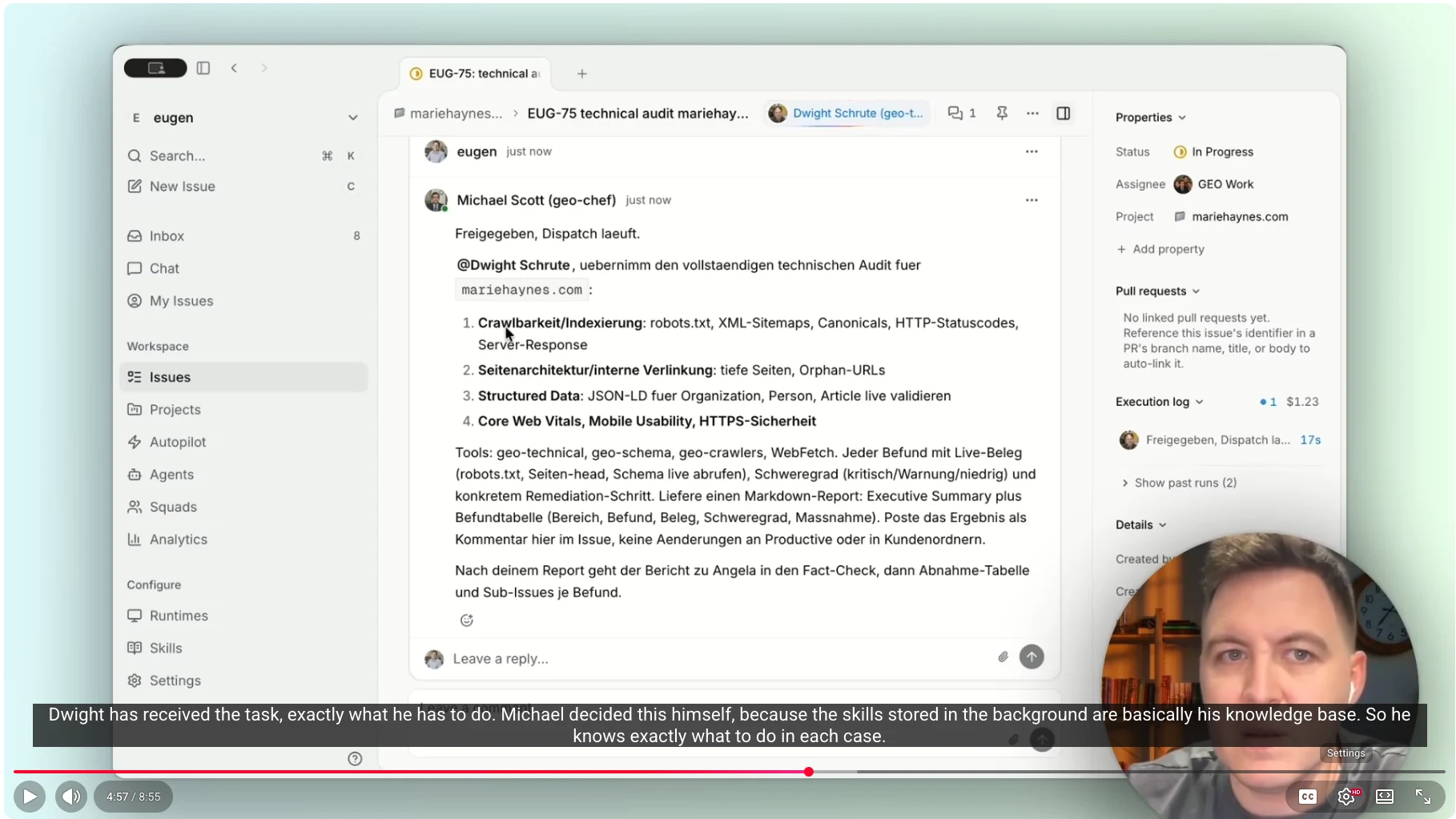
The real bottleneck is interpreting the data
Collecting data isn’t the problem anymore, and there are more tools for it than I have reading time. The hard question: what does it mean? That’s where AI is weakest. It presents correlation as cause. It fills gaps with plausible logic that was never in the data. The text reads clean, the number sounds right, and it’s still wrong. That’s why my system exists. It’s built on the assumption that a model will read something the wrong way.
The architecture behind it: a team of agents
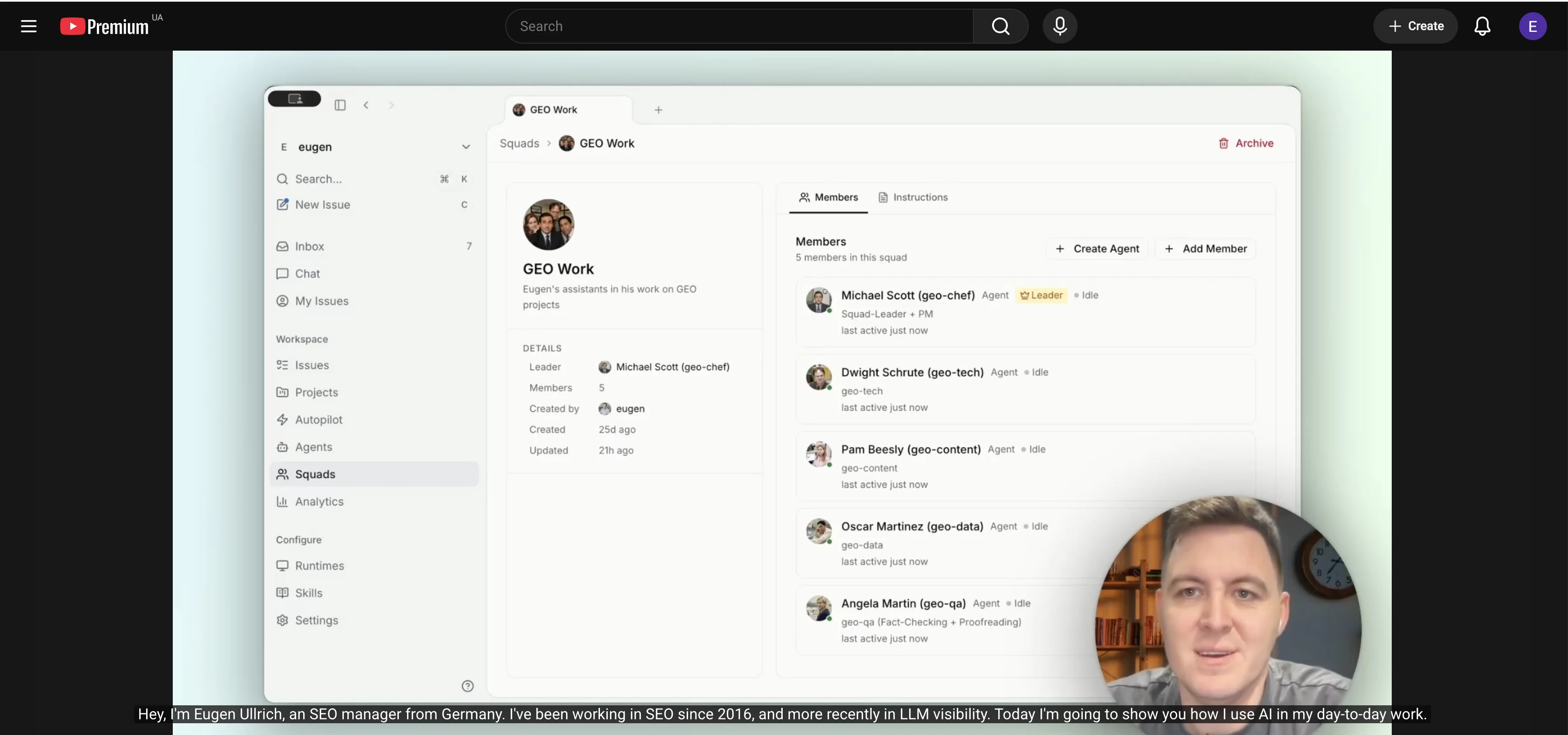
In my setup, the AI is a specialized team of agents. Each one has a fixed role, specific skills, and access to its own tools. A lead agent handles the task distribution.
I named the roles after “The Office,” because I’m a fan. Michael runs leadership and delegation. Dwight owns the technical side: crawling, schema data, bot access, and the robots.txt. Pam focuses on content and E-E-A-T. Oscar pulls the hard data from Peec.ai, Search Console, and tools connected over MCP. Angela is quality assurance.
The one rule of the process: four agents handle analysis and production only. A single agent may write the final document at the end, and only after two separate approval stages have been cleared.
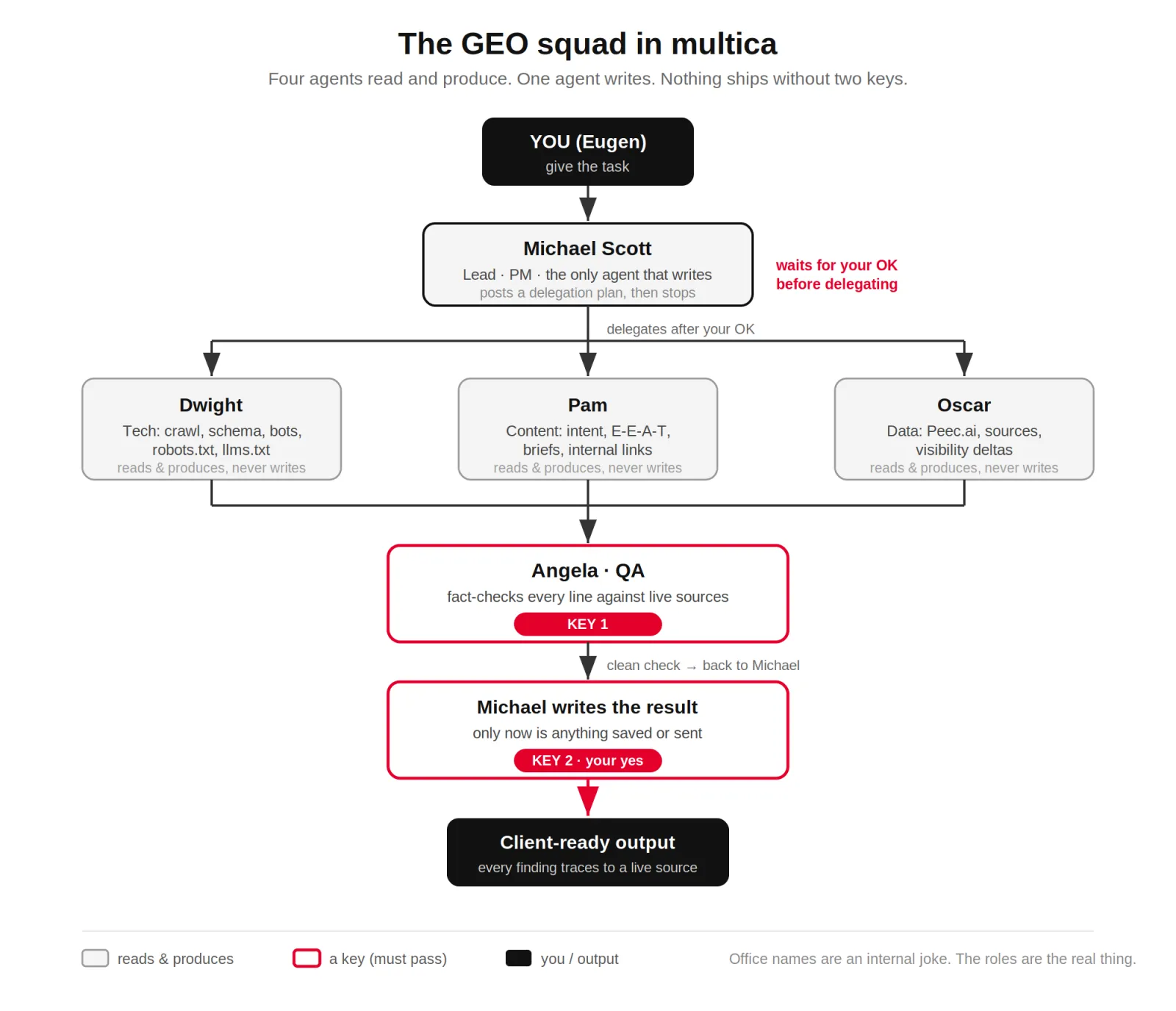
Three protective layers against unfiltered AI output
The time saved is large, and that’s where the trap sits. What used to take hours, the agents now deliver in minutes. And that’s the risk: every one of those fast deliveries has to be checked meticulously, so no client gets nonsense served up with confidence. My system runs three filters for that.
First layer: the foundation of rules. Every agent works against strict documentation and tightly defined requirements, anchored in the system as skills and instructions. It checks against its spec exactly, with no deviation.
Second layer: the fact-based counter-check. Angela does this step. She matches every result against the live source, whether that’s a fresh HTTP request, the latest snapshot, or the page’s real HTML. The system never relies on the general knowledge stored in the model.
For every line there are three outcomes. If it’s backed by evidence, it stays. If a detail is wrong, it gets an explicit correction. If the evidence is partly missing, the line is cut to save the rest of the report.
Third layer: the manual final sign-off. The human in the loop stays non-negotiable. No automation replaces my checking eye. Before a document reaches the client, I look hard at the strategy, the findings, and the wording. The report goes out only after my personal approval.
How much that matters shows in an example from my video: Dwight’s report failed Angela’s check. A synthesis claimed a visibility drop of 6 points, while the live data showed only 4. It sounded plausible and was simply wrong. Errors like that are dangerous, because at a glance they could pass as true.
Data protection: client data stays inside the machine
For complex tasks I use cloud models, but no prompt leaves my system unfiltered. A locally run model (Ollama) sits in between and replaces sensitive data like names or domains with placeholders like {{LAWFIRM}} or {{MAINDOMAIN}}.
The external model only works on the structural task, without knowing the actual sender. The placeholders are mapped back exclusively on my side, locally, when the final result is compiled.
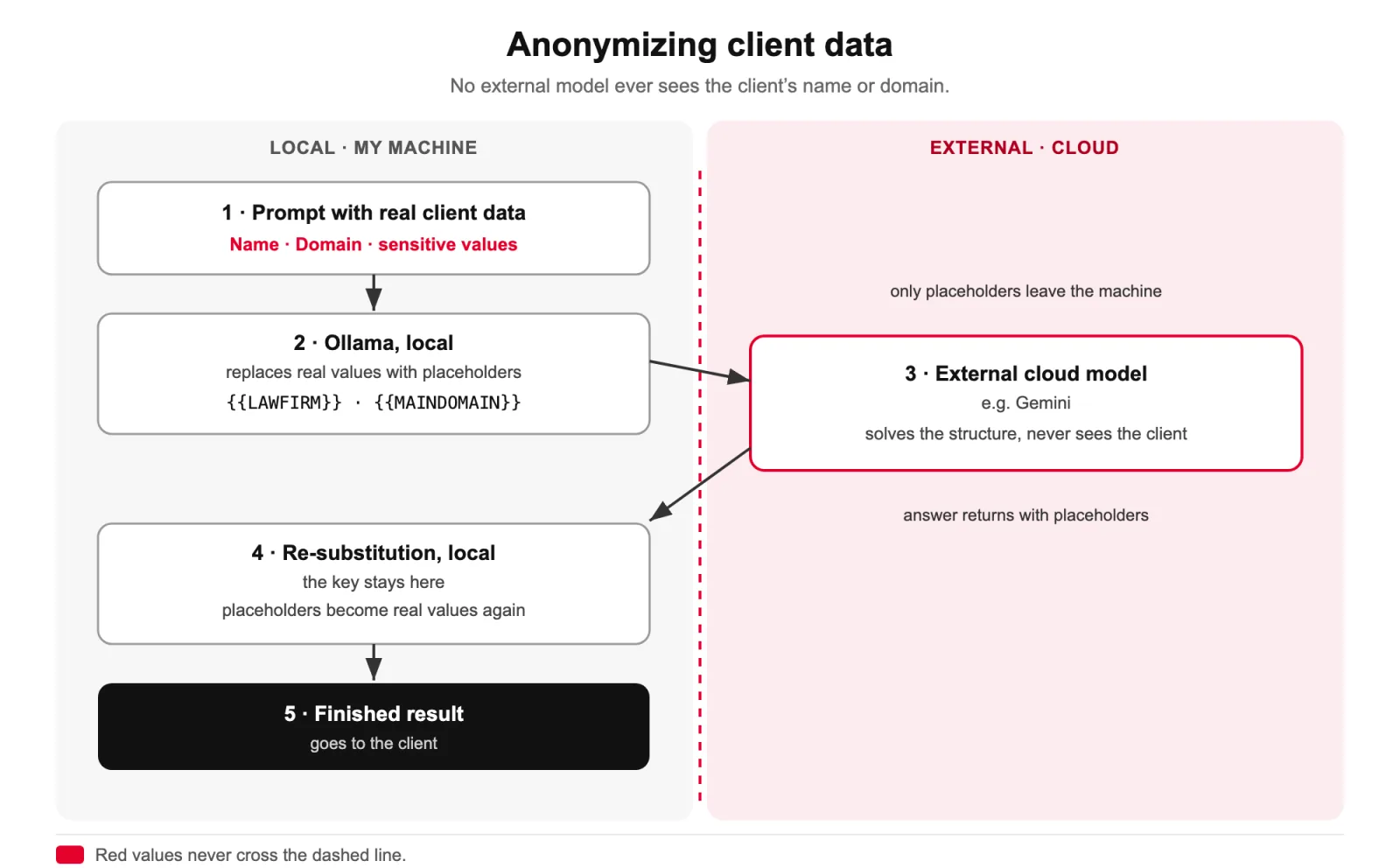
Let’s be honest here: the method protects the client’s identity and secrets from external models, even though the type of project stays structurally recognizable.
A ready-to-use prompt for your day
You can use this approach without a complex agent structure too. Let the model answer, then hand it back this:
Read your answer again. Rate it on three criteria:
1) factual accuracy, 2) completeness, meaning whether anything
important is missing, 3) clarity, meaning whether someone without
prior knowledge would understand it. Suggest changes that should
go into the text.
It’s often striking how many inaccuracies the AI catches itself on the second pass. This extra filter lifts the quality of your first draft noticeably.
Investment and what you need to build it
The financial outlay is smaller than you’d think. The models run through existing subscriptions, with no extra token costs. A simple VPS handles the orchestration.
The basic scaffold stands in about two hours. You can leave the technical server part to tools like Claude Code. The real work sits in the preparation: you have to define the role instructions, the skills, and above all the process you want to automate, precisely. No AI does that thinking for you.
Where automation works and where it doesn’t
You have to draw the limits clearly.
Strategic advice and deep business analysis are no place for agents. Here experience counts, and a feel for operational priorities: internal release cycles, say, or the business relevance of a technical fault. An AI can’t grasp that.
A perfect fit, on the other hand, are repetitive standard checks. Is the page readable without JavaScript? Does the schema markup fit? Are there bot blocks? Tasks like that I delegate to my system without hesitation.
Three areas stay firmly in human hands.
First, real causality. The AI often confuses correlation with cause and invents connections where there are none.
Second, prioritization. Only a human understands which technical faults are truly business-critical for the client in the current context.
Third, data skepticism. An AI doesn’t question its sources. Whether a crawl was distorted by a firewall is something the human has to spot. That’s why my final check is unavoidable.
Four guardrails for any AI process
Evidence is mandatory. Any claim without a direct live source is only a hypothesis. Treat such statements as unconfirmed.
Fresh context for the check. Always validate results in a clean environment against the original data. If you have to, use the single-window prompt method.
Quality over quantity. Better to cut an uncertain line than to risk the integrity of the whole report.
The human signature. A human has to approve the final document word by word. The final responsibility is yours.
Bottom line
Agents free me from the routine of collecting data and the first pass of preparation. That buys me time for what matters: the well-grounded decision. We work out what really counts and which data we can trust.
Automation is a time gain that comes with a new duty to control. Without that check, you just ship faster scrap. With it, you win back valuable hours for the work that makes the real difference.