GLM-5.2: the strongest open model is text-based and token-hungry
The Chinese lab Z.ai released GLM-5.2 on 16 June as full open weights under an MIT license, a day after it first reached only subscribers of the coding plan. Open weights means: anyone may download, self-host and adapt the model without being tied to a provider’s API. In the independent Artificial Analysis Intelligence Index, GLM-5.2 is thereby the strongest open model at present.
Before this headline grows too big, two caveats belong at the start, because they decide whether the model is fit for your work. GLM-5.2 takes only text, no images. And it consumes noticeably more tokens per task than comparable models, which partly eats up its low token price again. Both are more relevant to agentic coding and to the cost calculation than a placement in a leaderboard.
What GLM-5.2 is
The model has 753 billion parameters, of which around 40 billion are active per request. This design is called mixture of experts: the model is large but activates only a fraction of its building blocks for a single request, which makes it cheaper to run than the total size suggests. The context window is one million tokens, against 200,000 for GLM-5.1.
Important is the input side. GLM-5.2 understands only text. Z.ai does have its own image-model family, but it is not available as open weights. For frontend development this sounds like a hard disadvantage, because there a screenshot or a design often serves as the template. All the more remarkable is what the benchmarks show.
Strong in benchmarks, with a caveat
In Artificial Analysis’s Intelligence Index v4.1, GLM-5.2 reaches a value of 51 and thereby leads other open models like MiniMax-M3 (44), DeepSeek V4 Pro (44) and Kimi K2.6 (43). Simon Willison cautiously calls it “probably the strongest text-based open model,” and that caution is warranted: a number always holds for exactly the test that produced it.
Toward vendor-own benchmarks I am fundamentally reserved, and Z.ai itself sees it critically too. More telling is what is measured after release and independently. For exactly that Artificial Analysis added the AA-Briefcase benchmark, which tests agents on realistic business workflows, that is on creating spreadsheets, presentations and memos. There GLM-5.2 beats GPT-5.5 and sits only behind Claude Fable 5 and Opus 4.8. GPT-5.5’s shortfall, per the analysis, comes above all from weak preparation in the frontend and in the design of presentations, not from a lack of substantive competence.
One metric is worth a second look, especially for business use: the hit accuracy against a fact-check list in this task. Here Fable 5 leads with 56 percent, followed by Opus 4.8 with 38.7 percent, GLM-5.2 with 36 percent and GPT-5.5 with 33.4 percent. Even the best model thus reliably checks only a good half of the facts, the rest still needs a human. On the Code Arena WebDev, which measures frontend and agentic coding tasks, GLM-5.2 stands in second place behind Fable 5. That a pure text model lands so high there I had not expected.
The expensive catch: cheap per token does not mean cheap per task
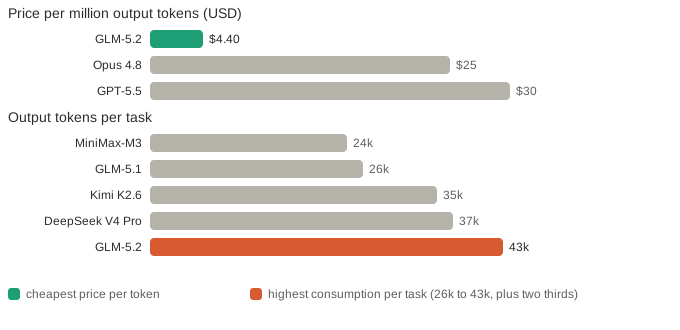
This is where the actual point sets in. Via OpenRouter, GLM-5.2 costs at most providers about 1.40 US dollars per million input tokens and 4.40 US dollars per million output tokens. For comparison, Willison cites 5 and 30 dollars for GPT-5.5 and 5 and 25 dollars for Claude Opus. Per token, GLM-5.2 is thus clearly cheaper.
Per token, not per task. Artificial Analysis measured that GLM-5.2 consumes around 43,000 output tokens per index task, against 26,000 for GLM-5.1 and more than other open models like Kimi K2.6 (35,000) or DeepSeek V4 Pro (37,000). Consumption per task has thus risen against the predecessor by around two thirds. At the same token price, the same task therefore costs around two thirds more, and the low price per token melts exactly where many tokens accrue: on agentic, multi-step workloads.
The lesson is not new, but it is easily overlooked: the relevant price is the one per completed task, not the one per token. Whoever compares models only via the price list talks up an advantage that the token hunger claws back in operation. If you are considering GLM-5.2, measure the costs on real tasks from your own workload, not on the tariff.
Architecture in brief
Two changes are worth mentioning. First, the attention mechanism was adjusted and an IndexCache added. Simplified: in the sparse attention procedure, the indexer’s results are reused across four consecutive layers, because they closely resemble one another anyway. This saves compute without losing much, similar to DeepSeek V4’s approach.
Second, and more discussed, the change in training: away from GRPO, the method proposed by DeepSeek, back to PPO from OpenAI. PPO requires an additional model that rates the quality of each token in the chain of thought. With GRPO, all tokens get the same signal, which is problematic because the step in which the model errs and the one in which it corrects itself are reinforced equally. The error is therefore not punished specifically. PPO separates this more finely.
What this means in practice
GLM-5.2 is a serious open model, above all for anyone who self-hosts and wants to keep control over weights and data. The MIT license makes that unusually free. For the choice, though, the two caveats from the start count. If your workflow needs images as input, say a design as a template in the frontend, the text restriction is a real hurdle. And before you rejoice over the token price, calculate the cost per task, because there it is decided whether “cheap per token” also means “cheap in practice.”
A note on the numbers: the prices on OpenRouter change quickly and are from 17 June, check them anew before a decision. The benchmark values hold as of now and for the tests used in each case.