Google's AI Overview barely cites Maps reviews – and the patent behind the claim has lapsed
In short
The claim that Google reviews are the entry point into AI Overviews chains two patents – one describes only a long-lapsed re-ranking step, the other a training method that names no product, and there is no connection between them. In a project with local demand, exactly one of 1,263 AI Overview citations over 30 days pointed at a Maps review; the attributable citations land 98.7 percent on provider and institutional pages.
Discuss with AIClaude ↗ChatGPT ↗
The chain is elegant. Google, the argument goes, holds a patent for identifying local experts whose reviews lift or sink a business in local search; a second patent trains language models with feedback from that very search; so whoever collects Google reviews ends up in the AI Overview. Elegant – and wrong in three places. The first document describes a re-ranking step, not a primary signal, and it has been lapsed for years. The second describes a training method and names none of the products the thesis is about. Between the two, there is no connection at all.
I read both patent documents, then spent 30 days going through AI Overview citations one by one in a project with genuine local demand: 1,263 citations, exactly one of them pointing at a Maps review page. This piece takes the chain apart link by link and shows, with my own data, where the citations actually land.
This is not an argument against reading patents. It is an argument for reading them carefully.
Why I read patents in the first place
Most of what I find on this topic is theory without an evidentiary base. Getting that base is hard, because the algorithms are closed – trade secrets. That leaves two routes: practitioners you can trust, along with their calculations and their experience. And a look behind the curtain – Google’s own documentation, and the patents Google has filed.
I build visibility strategies and action plans for clients that run over months and years. I cannot afford to put measures into them that will not work. It would be equally wrong to push the responsibility onto the client and run research at their expense to find out what works in the first place. A client’s budget is not a research grant. Whoever writes a measure into an annual plan is accountable for its justification.
Patents are one of the few legitimate windows into a closed system. Which is exactly why you must not misread them.
An image I will carry through this whole piece: a patent document is a building file, not a photograph of the finished house. It shows what somebody intended to build, by what method, and how much of it they secured. What actually stands at the end is not in there. The file has load-bearing walls – those are the claims – and beside them marginal sketches the architect attached in case they might come in handy one day. It also carries a note on whether the fees are still being paid. Those three places do most of the checking work.
The thesis currently going around
It has been running through agency blogs and LinkedIn posts for weeks, usually with the same patent number attached and rarely with a single claim quoted. In its strongest form it goes like this. Google holds a patent on identifying local experts: users who write conspicuously many and conspicuously good reviews in a given area and a given business category carry more weight than others. Their verdict lifts or sinks a business in local search. A second, much younger patent describes how a language model is fine-tuned with feedback from a search engine. Put the two together and you get a closed narrative: whoever ranks at the top of local search shapes the model, and the model names them in the AI answer. Reviews would then be the entry point into generative search.
It is a good story. It has the advantage that every step sounds plausible on its own, and that at the end there is a measure you can sell. Anyone who fails to state it at full strength first is refuting a caricature.
What the first patent document actually says
The document in question is US 10,929,409 B2, “Identifying local experts for local search,” assigned to Google LLC, inventors John Alistair Hawkins and Cristina Stancu-Mara. Priority date: 30 April 2013.
The mechanism it describes is cleanly built, and anyone who understands local search will read it with profit. The system forms pairs of geographic area and business type and looks for candidates inside them. The expertise score is, at first, simply the number of a user’s reviews within exactly that pair. How strongly they count as an expert then depends on how far their judgment agrees with the searcher’s – in the patent’s words, the “agreement score.”
The reviews themselves are filtered and weighted by age, length, and user signals about helpfulness. Short texts are discarded, because experts, per the document, “tend to write longer, more informative reviews.” Linguistically conspicuous text goes the same way, checked through telltale n-grams and “sentence structure indicative of low-quality review.” And a spam detector runs across all of it.
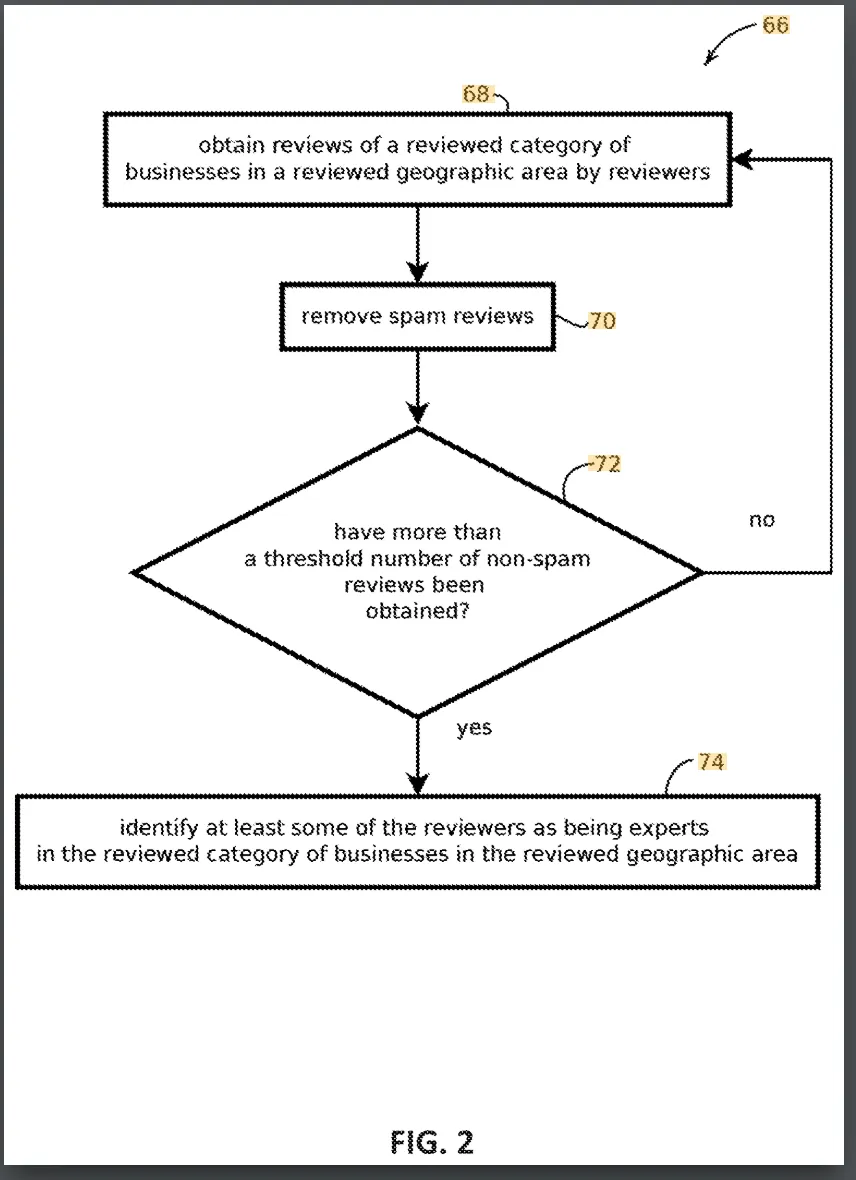
Up to this point the document rather supports the thesis. Then comes the sentence that tips it over. The ranking module “adjusts the ranking or scoring of the local search results based on reviews of the identified experts.” And one paragraph further, spelled out: “the ranking for a local search result is based on its distance to the query location, its relevance, and the weighted average rating of the experts.”
In this document, expert reviews are a correction factor applied to an existing ranking built from distance and relevance. Not a primary signal. Anyone citing this patent as proof that reviews determine local ranking has read the sentence and skipped the verb.
Why the claims say something different from the description
This is where the transferable craft sits, and it matters more than the specific case.
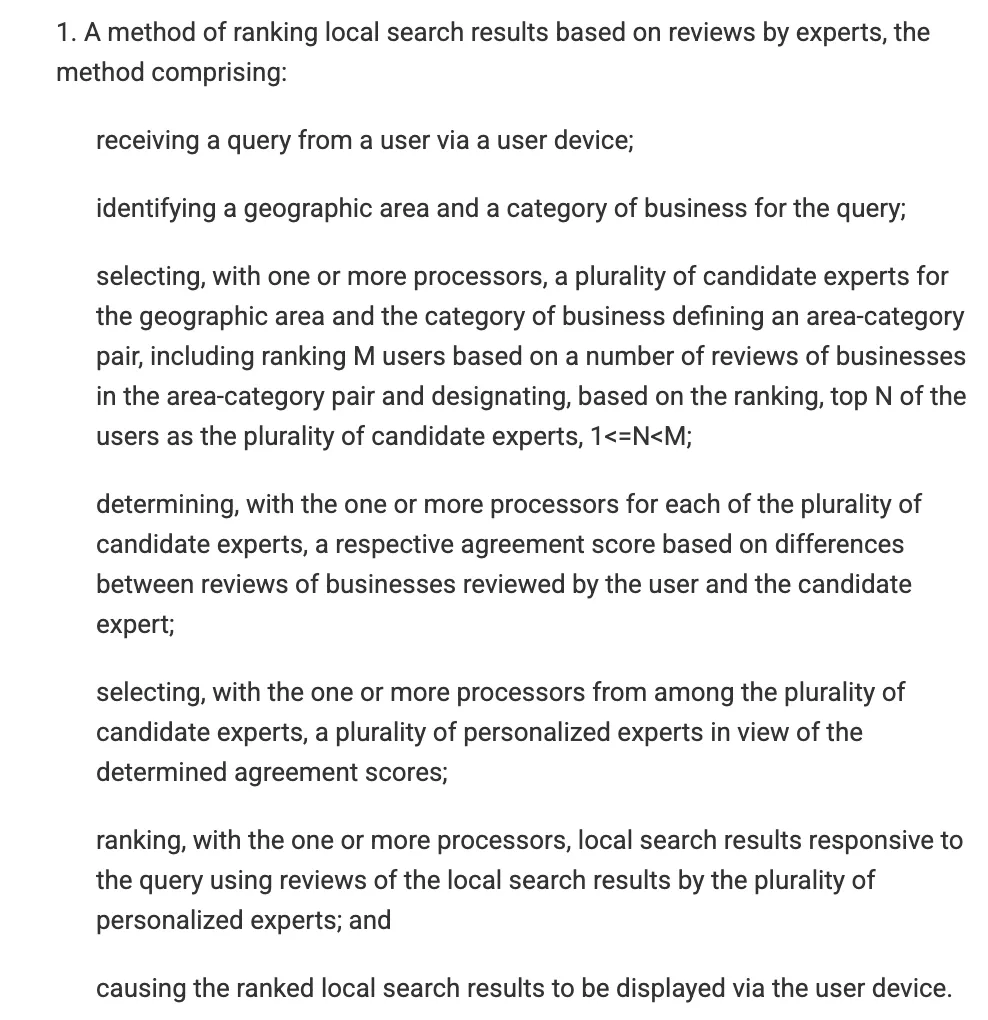
A patent document consists of two very unequal parts. The description is allowed to roam; it sketches embodiments, variants, possibilities. None of that is protected. Only the claims are binding, and among them above all independent claim 1: the load-bearing wall. Anything that appears first in a dependent claim is a marginal sketch. Optional. An addition the applicant wanted covered without making it a condition.
Test the thesis against that dividing line and little survives. Claim 1 selects candidates solely by the volume of reviews. And it demands something nobody in the discussion mentions: expert selection is tied to the individual user, through that user’s agreement with the candidates. The method is a personalization method.
Then there is the language of the description. Where the other side collects its evidence, the text says “in some cases” throughout. The patent explains its own word choice in one place: “the word ‘may’ is used in a permissive sense.” These formulas mark embodiments, not commitments. A text that keeps every option open is poor evidence for the one option you happen to need.
The legal status nobody looked up
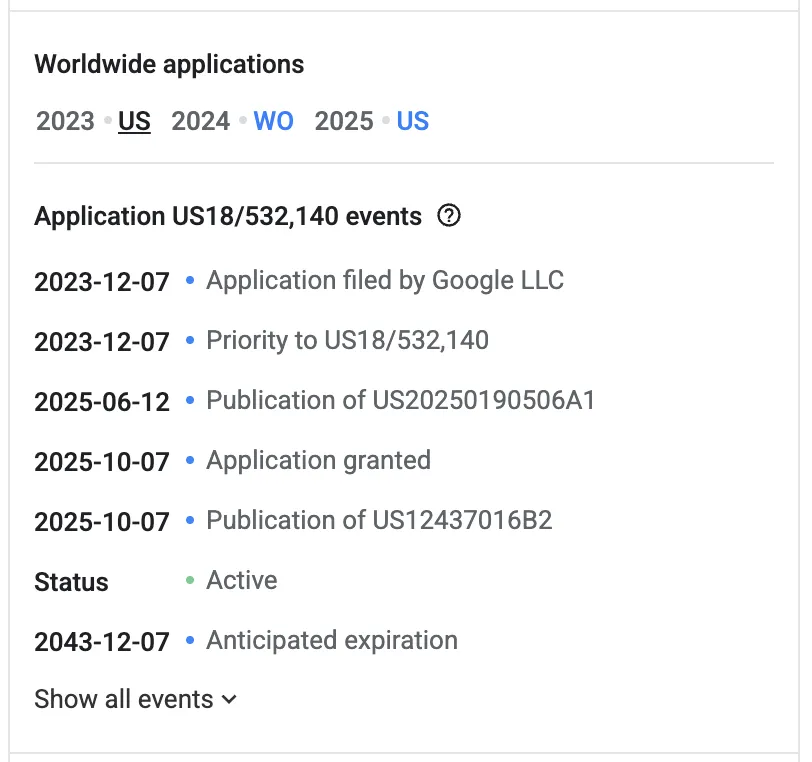
Google Patents shows this document as “Expired – Fee Related.” It was granted in 2021, priority sits in 2013, and the document is a continuation of the original application of 30 April 2013. Google is no longer paying the fees. The second document, which comes next, sits beside it as “Active.”
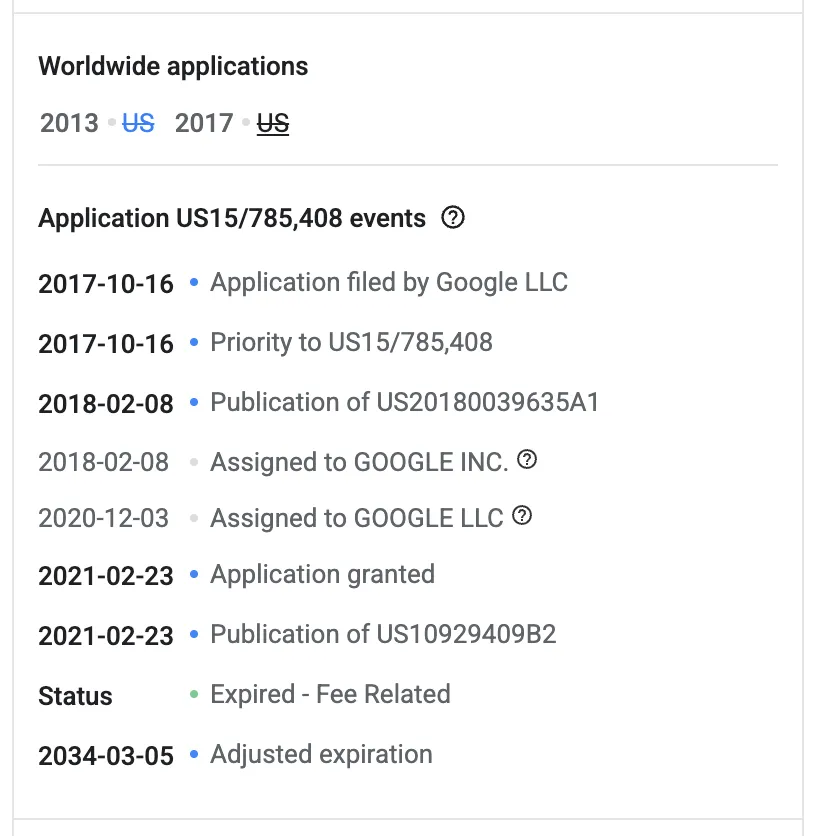
To be fair about it: lapsed does not mean unused. A company can keep running a method and still let the file expire, for instance because protection against imitators is no longer worth the cost. Legal status is an indication of priority, not proof of disuse. Google Patents attaches that caveat to the timeline itself: “Google has not performed a legal analysis and makes no representation as to the accuracy or completeness of the events listed.”
What remains is still awkward for the thesis. It rests on a building plan from 2013 – from a time before Local Guides in their present form and long before AI answers – whose owner has stopped paying the fees on the file. That is not a strong foundation for an action plan covering the next twelve months.
The second patent describes training, not your search query
The second document is US 12,437,016 B2, “Fine-tuning large language model(s) using reinforcement learning with search engine feedback,” filed in December 2023, granted on 7 October 2025, legal status active.
It describes a training method. You let a language model answer twice, once with search results in context and once without, and compare: “a supervision signal can be generated based on comparing search engine conditioned LLM output with unconditioned LLM output.” Claim 3 specifies that this signal “indicates a preference for the search engine conditioned output over the raw LLM output.” Out of that comparison comes a reward model, and with it the model is fine-tuned.
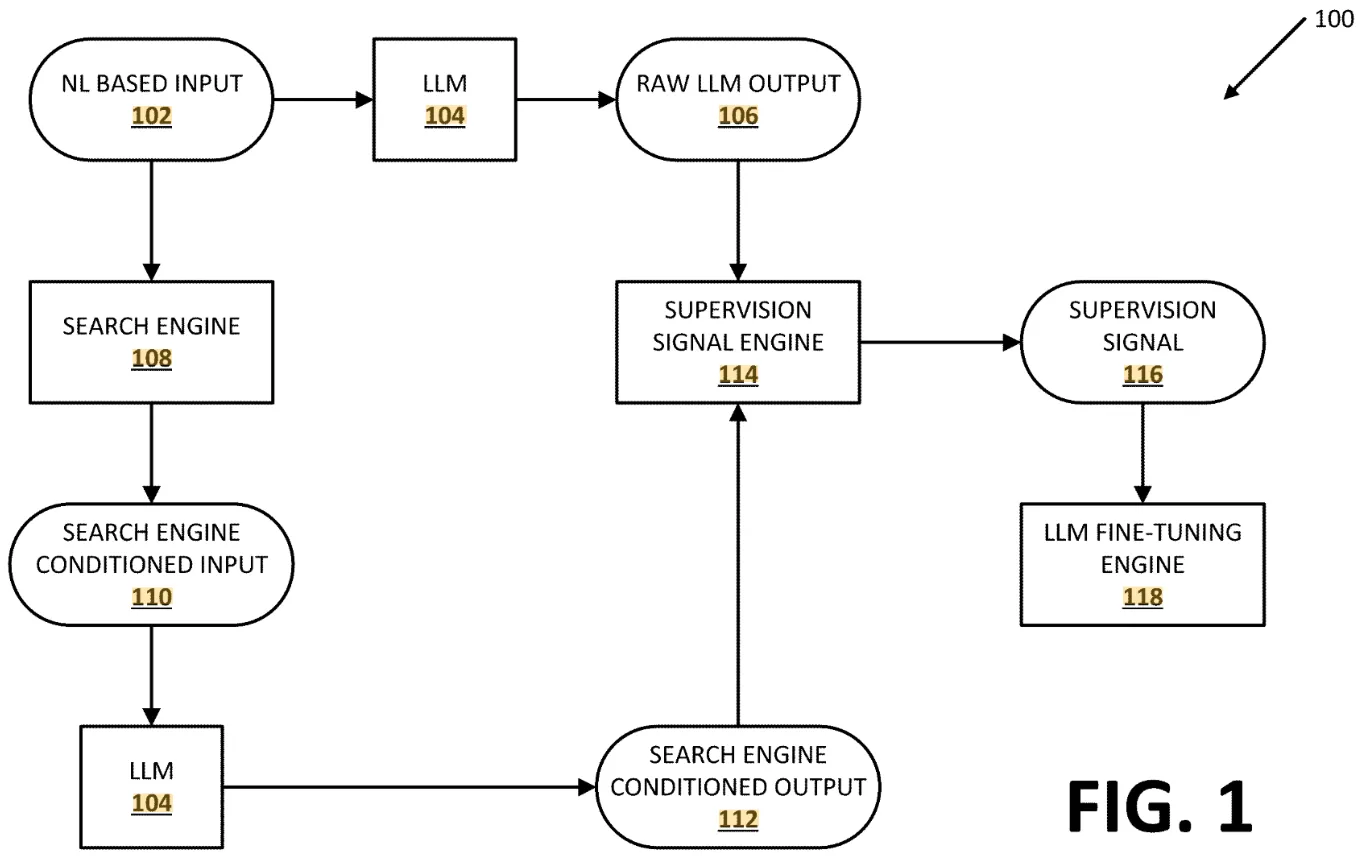
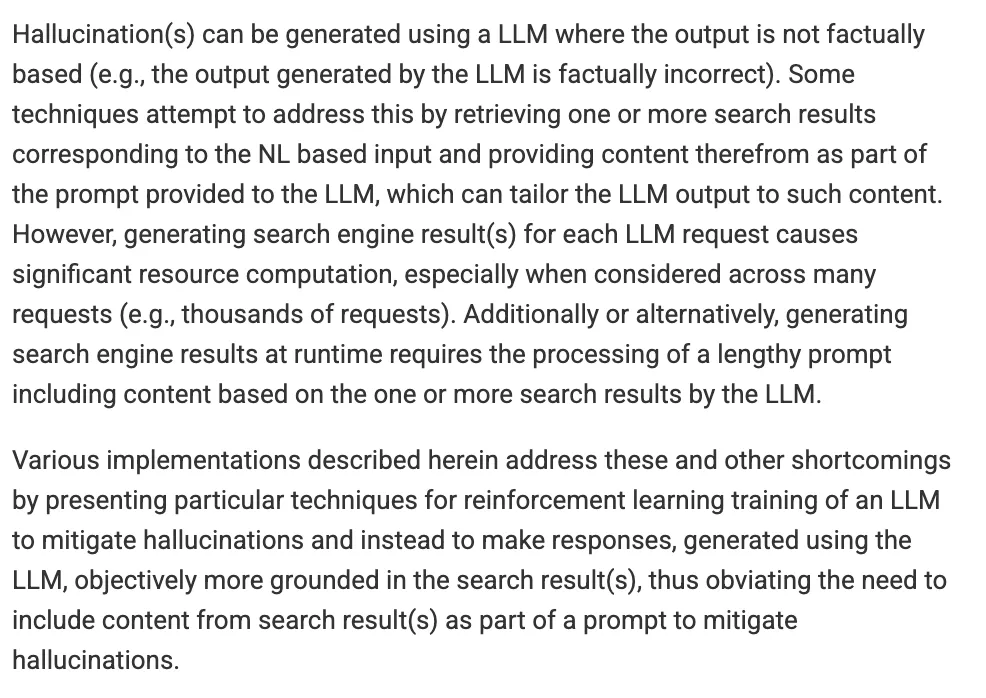
The purpose of all this effort is stated in the document too, and it inverts the popular reading. The applicants consider search results at runtime too expensive: “generating search engine result(s) for each LLM request causes significant resource computation,” plus the processing of a lengthy prompt. So the method is meant to get search out of the prompt, “thus obviating the need to include content from search result(s) as part of a prompt to mitigate hallucinations.” It does not describe how a search engine feeds an AI answer. It describes how to avoid that step.
And then the negative finding. I searched the full text of both versions case-insensitively: no hits for “AI Overview,” none for “AI Overviews,” none for “SGE,” “Search Generative,” “Gemini” or “Bard.” Not one of the products the thesis is about is named – no AI Overview, no Maps, no Gemini. The only things named are models as technical examples: “LaMDA, BERT, Meena, PaLM, GPT-3, GPT-4.” The application context the document sets up for itself is “automated assistants” in dialogue with humans.
Anyone deriving the workings of AI Overviews from this document is reading in something that is not there.
There is no connection between the two patents
Short and hard: neither document cites the other, in either direction. They share no inventor. They carry different main classifications – G06F16/9535 for search personalization, G06F40/35 for dialogue processing. Between the priority date of the first and the filing of the second lie ten years and a change of technology.
One qualification I add myself, because it surfaced while checking: in the secondary classifications the two documents do touch. Both sit under G06F16/953, the branch for processing search queries; the first ends in /9535, the second in /9538. Anyone determined to construct a kinship has a foothold there. It carries nothing: tens of thousands of documents hang under that branch, and a shared drawer is not a shared statement.
The bridge between the two remains inferred, not evidenced. Whoever asserts it carries the burden of proof.
What AI Overview actually cites in a project with local demand
A patent check invalidates a justification. It does not replace a measurement. So I measured.
The project is a Swiss service provider in the health and therapy sector with a local catchment area, tracked through Peec.ai in the Google AI Overview channel, period 25 June to 24 July 2026. Over those 30 days there were 179 AI Overview answers, with citations to 184 distinct source domains and 1,263 citations in total.
Of those, google.com/maps/reviews/* accounts for one citation. One.
Take all directories and review platforms together – Maps reviews, the two large Swiss business directories, and Facebook – and you get 13 citations. That is 1.0 percent of all citations. On the other side stand 1,020 citations on provider and institutional websites: the pages of practices, clinics, associations, professional bodies, authorities. That is 98.7 percent of the attributable citations.
Four limits on that number, and they belong here rather than in the small print.
First: one project, one sector, one country, 30 days. That supports a statement about this project and a well-founded doubt about the general thesis. It supports no statement about “local search in the DACH region.” Second, there is a black box in the data. 230 of the 1,263 citations – 18 percent – point at google.com/searchviewer/* URLs whose target content cannot be resolved. What sits behind them, I do not know. So the rate is calculated without those 230, and both figures are stated openly: 1.0 percent against all citations, 1.3 percent against the 1,033 attributable ones. Third, Peec measures what is listed as a source in the delivered answer, not the underlying retrieval. A source can be retrieved and never named; how large that gap is, I measured across eight B2B projects in the retrieval-to-citation funnel. Fourth, the Local Pack itself is not part of this measurement. The statement is about what AI Overview cites – not about what Google Maps ranks.
And the figure “exactly one Maps citation” is rhetorically stronger than it is statistically. At 1,263 citations, the difference between one and five hits is noise. What holds is the order of magnitude: around one percent, not the single observation.
Six more projects, and a counter-finding
One project is too few, so on the same day I went through the other Peec projects where AI Overview is queried locally or around store networks: a Swiss excursion destination, a German pet supplies retailer with a store network, a German beauty chain, two grocery retailers and a Swiss DIY chain. Partly active clients, partly closed pitches.
I excluded the DIY chain. AI Overview shows retrievals there, but zero citations across all domains. Whether the delivered answer contained no citations or the recording was incomplete cannot be resolved – and using a project whose metric is uniformly zero as evidence for “no review citations” would be circular reasoning.
In four of the remaining five projects, no Google Maps URL, no classic review platform and no business directory appears among the most-cited domains in AI Overview. Yelp shows up in one project with two retrievals and zero citations. What gets cited are manufacturer and retailer pages, trade publications, institutions and YouTube. To be precise: for these five projects I have the top 30 to top 60 domains depending on the project, not the complete list. What follows from that is “not among the most-cited sources,” not “zero citations.” So I give no percentages for these projects. Two of them are also from 2025, and the AI Overview of 2025 is not the one of 2026.
Now the counter-finding, and it sits in the same dataset. For the Swiss excursion destination, AI Overview cites tripadvisor.ch 50 times, Instagram 43 times, Komoot 27 times. Review and community platforms very much are a citation source there. So the statement is not “AI Overview does not cite reviews.” It is: the effect depends on the sector, and in none of the sectors examined does it support the asserted chain from a Google Maps review profile into the AI citation.
A second pattern struck me along the way, and it reaches beyond this article. Directories are not disappearing from AI answers – they are disappearing from this one engine. Same project, same period, same prompts:
| Directory or booking domain | AI Overview | ChatGPT | Perplexity |
|---|---|---|---|
| local business directory A | 3 | 170 | 137 |
| local business directory B | 6 | 52 | 102 |
| appointment booking portal A | 0 | 30 | 5 |
| appointment booking portal B | 0 | 19 | 0 |
The same picture at one of the grocery retailers: a leaflet and offers portal collects 108 citations there – in Perplexity, not in AI Overview. Reddit 47 there, likewise Perplexity. Anyone building visibility through directories is working a real lever. Just not the one the patent thesis promises.
What follows from this, and what explicitly does not
First, what does not follow: that reviews are worthless. I contradict that sentence explicitly.
Reviews remain an external authority signal. They cannot be produced in arbitrary volume, but they can be requested systematically: an online shop filters successful deliveries – on time, no complaints – and asks exactly those customers for a review, on its own site or on platforms such as Trustpilot. That requires a strategy of its own, including how to handle negative voices: the dissatisfied customer writes more readily than the satisfied one.
Reviews are also an important source of knowledge about the product or the shop for a particular phase of the customer journey – and language models use them in training and pre-training. Which purchase uncertainty demands which evidence in which phase, I worked through for retail in a separate piece on buyer uncertainties in the sales funnel.
Those are two different mechanisms of action, and the patent thesis conflates them. Reviews work through conversion, through Local Pack position, and through the fact that models saw them during training. What they do not do in my data is appear as a cited source in AI Overview. Anyone budgeting review work with the goal of “AI citation” has grabbed the lever at the wrong end – the work itself remains right.
The objection coming now is legitimate, so I will take it on directly. Google states itself that its AI features build on the same index and the same ranking systems as classic search, and for local queries Google displays map modules with review stars in the interface. Both are true. Both hit a different target, though: that Google displays review data in a module of its own does not mean the generated answer draws its facts from reviews or names review platforms as a source. That distinction is exactly what my number measures. And I contradict at no point the local SEO research that has shown correlations between review profile and Local Pack position for years. My objection is to the justification via these two patents and to the transfer onto AI Overviews.
That leaves the practical consequence. If in a locally queried project 98.7 percent of the attributable citations go to provider and institutional pages, then the AI citation is decided on your own page. It has to carry the answer itself: name the service in the language of the question, spell out the catchment area, answer prices, deadlines, responsibilities and exceptions in one place instead of scattering them across subpages. How models make that selection I have written up elsewhere, on how ChatGPT chooses its sources and on the gap between retrieval and citation.
How to check a patent thesis in five minutes
This is the routine I use to clear or confirm such claims before they migrate into an action plan. You need no patent law for it, only Google Patents and full-text search in your browser.
- Open the legal status. Go to
patents.google.com/patent/<number>/en, read the “Legal status” field and note Active, Expired or Abandoned along with the priority date. - Full-text search for the product name. Use Ctrl+F for “Maps,” “AI Overview,” “Gemini” or whatever product the claim is about. Zero hits means the claim did not come from the patent.
- Read claim 1 only. Whatever is not in there is optional – even if the description spends a page on it.
- Sound out the description. “in some cases,” “may,” “in some implementations” mark embodiments, not commitments.
- Check the family. If the document is a continuation, the description is older than the number suggests. The priority date beats the grant date.
In my experience, steps 2 and 3 settle nine out of ten cases.
When this check makes sense and when it does not
It makes sense for any thesis resting on a primary source nobody has opened. You recognize that by a pattern: every post names the same patent number, none quotes a claim. Five minutes with the routine above and you know whether you are dealing with a finding or with a retelling.
It does not make sense as a substitute for your own measurement. A patent check invalidates a justification; it does not supply a strategy. It tells you what not to do and stays silent about the rest.
And the figures above hold for six projects, precisely quantified for one of them. Anyone adopting them instead of measuring makes the same mistake as the other side: using someone else’s source as evidence for their own case. Pull the domain report for your own AI Overview channel, sorted by citation count, and look at what sits at the top. It takes less time than the patent check.
Frequently asked questions
How hard do Google’s AI Overviews push down click-through rate? Considerably. In February 2026 Ahrefs ran 300,000 search terms against Google Search Console data: at position 1, an AI Overview correlates with a 58 percent lower click-through rate, up from 34.5 percent a year earlier. That is the mechanics of zero-click search – impressions stay, clicks go. If impressions hold in your Search Console while clicks fall, your SEO is still working; it just no longer pays out in visits.
What organic ranking do you need for a citation in an AI Overview? A top-10 ranking is neither a condition nor a guarantee. In Ahrefs’ analysis of 863,000 SERPs, only 37.9 percent of cited pages also appeared in the first ten results for the same query, and 31 percent were not even in the top 100. The reason is query fan-out: Google’s search algorithm breaks the query into sub-questions and cites what surfaces in those secondary SERPs. Your page has to rank for the sub-questions, not for the main one.
How often do review platforms show up in AI Overviews at all? More often than my local numbers suggest, but in a different segment. As of 1 December 2025, SE Ranking analyzed 30,000 commercial search queries: 34.5 percent of AI Overviews cite at least one review platform, yet those platforms account for only 8.5 percent of all links. Almost nine in ten of those links go to five B2B software platforms, led by Gartner Peer Insights, G2 and Capterra. Trustpilot and OMR Reviews were not part of the sample of 23 platforms; Yelp came in below one percent of citations. Phrasing matters too: for explicit review questions the share sits at 49 percent, for “best” and “top” only at 17.1 percent. In tourism the picture matches my data – there AI Overview cites Tripadvisor 50 times in a month. In local services, practically never – there the same directories collect their triple-digit citation counts in ChatGPT and Perplexity.
Which sources dominate the links in German-language AI Overviews? For the German-speaking market I know of no robust analysis, and I have found no evidence anywhere for the claim that Trustpilot and OMR lead the field. Other things are documented. Across languages, YouTube is according to Ahrefs the most-cited domain in AI Overviews, with 34 percent growth in six months, Reddit following; in the SE Ranking analysis, provider, shop and documentation pages account for 72.5 percent of all links and appear in 99.1 percent of AI Overviews. My six local projects show the same pattern: provider and institutional pages, trade publications, YouTube. Wikipedia works less through the link than through the entity – it is one of the sources from which a model knows who you are at all. E-E-A-T is Google’s language for its human raters, not a dial you turn. What counts in practice is brand presence beyond your own domain: in Ahrefs’ analysis of 75,000 brands, mentions on YouTube correlate most strongly with visibility in AI Overviews.
What risk does negative customer feedback create in AI answers? A different one from what most people expect. The danger is rarely that an AI Overview quotes your worst review. It is that community platforms are a large citation class you do not own: in the SE Ranking analysis, social platforms and communities account for 13.4 percent of all links and appear in 60.1 percent of AI Overviews, with Reddit among the most-cited domains overall. In my own data, Reddit collects 47 citations in one retail project, in Perplexity. Online reputation management therefore shifts from deleting to answering – a factual reply under a complaint gets read along and cited along. To steer it you need sentiment analysis across channels rather than a star average, and a view on which statements about your customer experience you are willing to accept inside model knowledge. Brand safety here simply means: you know what gets cited before a customer reads it.
Do structured data and formatting earn a citation? Not as a lever you pull. Markup with Schema.org, delivered as JSON-LD, makes your entities unambiguous for machines and decides rich results. It does not buy a citation in an AI answer, and I know of no published study showing that it does. The idea behind the semantic web still holds, only one level down: what matters is whether a single passage answers the question completely, without the rest of the page. Plain HTML elements work harder at that than any markup. A heading that states the question verbatim, the answer below it in two sentences, prices and responsibilities in text rather than in a graphic. That is the craft core of generative engine optimization: not marking up the page, but making it decomposable.
Does Google rank local businesses by expert reviews? Patent US 10,929,409 B2 describes a method in which expert reviews adjust an existing ranking built from distance and relevance – “adjusts the ranking.” It is not a primary signal, and whether Google operates the method the document does not say. It describes an intention from 2013, not an operating state. Google Patents now lists it as “Expired – Fee Related”; that does not mean the method is not running, only that Google no longer pays the fees.
Do the two patents name AI Overviews? No. A full-text search across US 12,437,016 B2 returns zero hits for “AI Overview,” “SGE,” “Gemini” and “Bard.” The models it names are LaMDA, BERT, Meena, PaLM, GPT-3 and GPT-4. The second document also describes how to keep search results out of the prompt, not how to get them in.
How do you check for yourself whether a patent thesis holds? Read the legal status and the priority date, run a full-text search for the product name being claimed, read claim 1 only, and sound out the description for “in some cases.” The complete routine is further up in this article. It takes five minutes and costs nothing.
In closing
The chain fails in three places: the first document describes a re-ranking step and has lapsed, the second describes training and names no product, and between the two there is no connection. My measurement does not settle that on its own; it only shows where the citations in six projects actually land – on the providers’ own websites.