Lab · Project
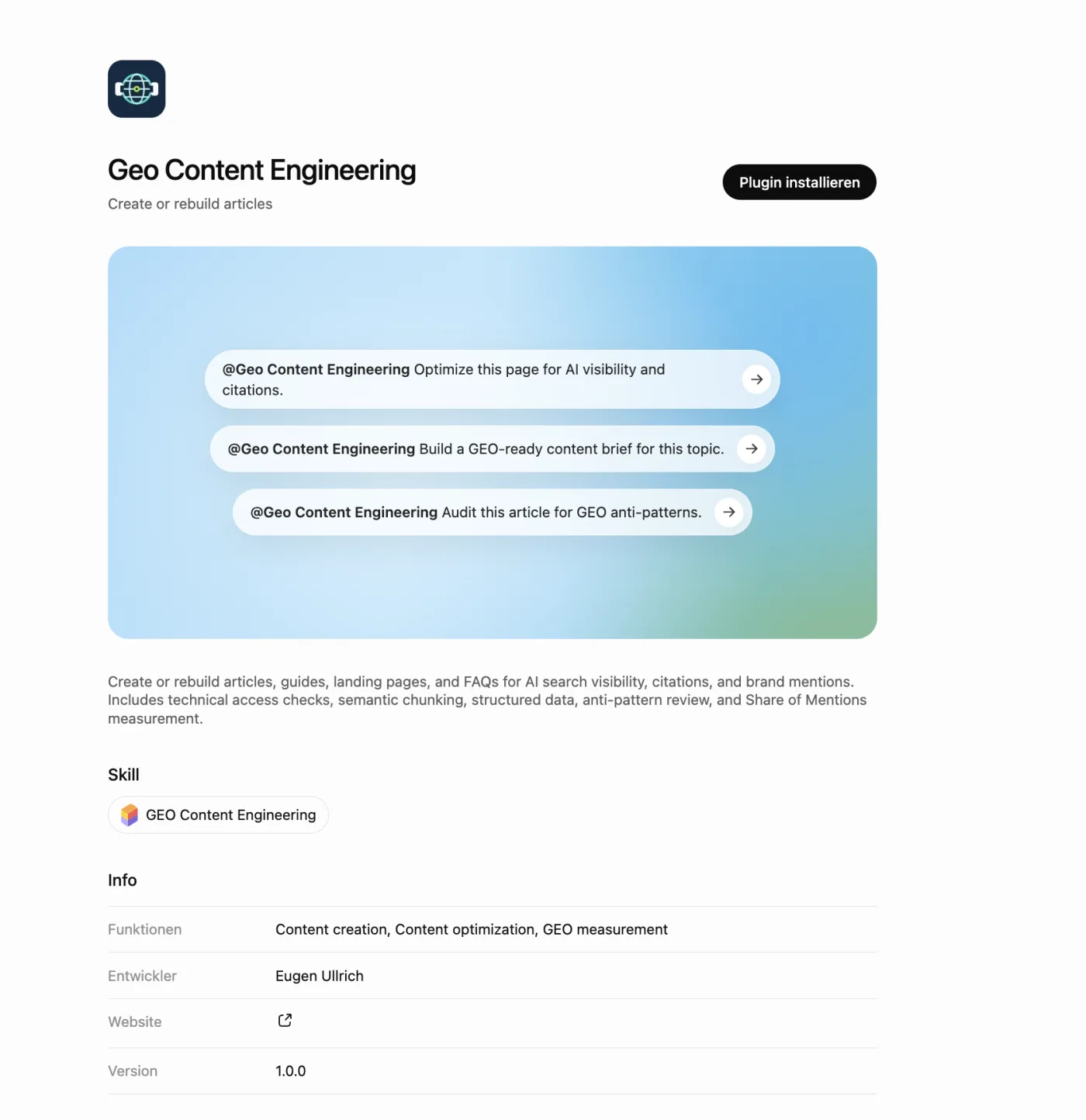
GEO content engineering: the method as an open agent skill
Open source · CC BY 4.0 · two modes
Starting point: writing is not the bottleneck
AI agents can write entire pages in minutes. That alone does not make a page retrievable or citable. Generative Engine Optimization (GEO) examines the technical, semantic and editorial signals that influence visibility in answer systems. The skill translates that work into a format an agent can execute step by step.
What the skill does
The skill gives a general agent a specialized workflow. As a simplified operating model, it uses the chain chunk, embed, retrieve, ground, cite: content is split, embedded, retrieved, connected to evidence and, where appropriate, cited. Weakness at one stage lowers the chance that content is used in an answer; it does not prove why one system omitted a source.
The skill applies this mechanic as a repeatable workflow: gate crawler access, structure text into independently extractable blocks, make claims citable with concrete data, cover the query fan-out of a question, keep content verifiably fresh, add verifiable authorship, apply correct semantic markup and JSON-LD, strip machine-tell language, publish with an input register. At the end, one number gets measured: Share of Mentions against a competitor benchmark.
Two modes, one order
The skill has two operating modes: creating new content and rebuilding existing pages. For rebuilds, the rule is: baseline first. Measure where the page stands today, then change it. It is the same order I work in on client projects – measure, prioritize, execute.
Structure
geo-content-engineering/
├── SKILL.md        workflow core + reference map
├── references/     concept depth, loaded on demand
├── assets/         paste-ready templates and JSON-LD
└── LICENSE.md      CC BY 4.0
SKILL.md carries the workflow and points to the references; the agent loads the concept files only when it needs them. In assets/ sit templates and JSON-LD ready to paste. The license is CC BY 4.0: use it, adapt it, pass it on – with attribution.
I use the same workflow for new and revised content on this website. That is a working rule, not a guarantee about every older page.
It started with the question of which verifiable steps sit between a finished text and visibility in AI answers. The answer is now an open tool: get the skill on GitHub or open its ChatGPT catalog entry, and put your agent to work with it. And if you want to know what the method yields for your brand: write to me.