Case StudyB2C Comparison Portal · Payments & Financing
Better positions and more organic clicks for a B2C finance portal
A B2C comparison portal for payment and financing solutions set out to grow organically in Germany's tightly contested market. Through transaction-focused payment-method landing pages and structured data, the average Google position in the core market rose from 16.9 to 13.0, with around 190,000 clicks in six months (+10%) and near-identical impressions.
Published Last reviewed
Result
Avg. Google position in the core market
Focus: Payment-method landing pages, structured data, position and click-through rate
Scope: SEO analysis, landing-page optimization, product rich results
Evidence boundary
What this case supports
- Evidence basis
- The organic-search metrics stated in the six-month comparison.
- Scope
- An anonymized B2C comparison portal in its German core market.
- Public evidence
- No standalone public artifact is published.
- Data source
- Google Search Console.
- Period
- Six months; DACH with a focus on Germany.
- Primary metric
- Average Google position in the core market: 16.9 to 13.0.
Limit: The comparison describes the project-period change. It does not isolate one measure's effect or forecast outcomes for other portals.
Case Study
Overview
A few transaction-focused pages carried the growth.
The market is crowded. Many providers press for the same generic terms around credit, installment payment, and invoice purchase. Part of the traffic sits with the brand anyway. Across six months, the baseline stood at roughly 172,000 organic clicks.
My job was to strengthen the pages that actually lead to conversions, and to lift positions where the user is already searching with intent to buy.
Focus: payment-method landing pages, structured data, position and click-through rate.
Scope: SEO analysis, landing-page improvements, product rich results.
Approach
I measured the portal against its real purchase paths. Where does someone land who’s looking for a specific installment purchase or a financing option? Which page answers that intent, and does it rank well enough for it?
The answer was sobering. The purchase-ready pages were there, but they sat too far back and drew too little from their impressions. So I shifted the weight: away from high-reach head terms, toward the payment-method pages and clean structured data, so Google serves product rich results.
No rebuild of the whole site. A handful of pages, done right.
The central decision
In a generic B2C setting, reach pulls your eye. Head terms bring impressions, but rarely the click that counts.
I switched the metric on purpose: from impressions to position and click-through rate on the money pages. That moves what the whole effort aims at. A page at position 22 with plenty of impressions is worth less than a page at position 11 that picks up buyers.
Result
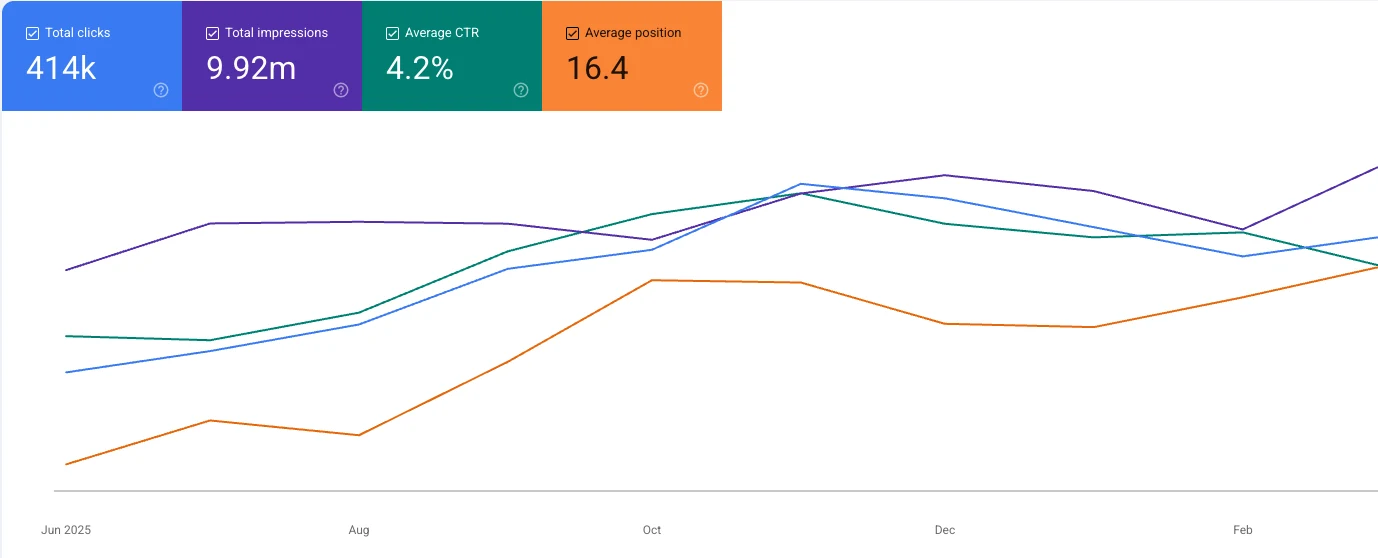
Across six months, the average Google position in the core market improved from 16.9 to 13.0. On mobile, where most of the traffic happens, it moved from 13.4 to 11.1; on desktop, from 27.8 to 21.0.
Organic clicks rose by about 10 percent, from roughly 172,000 to 190,000. The path there matters. Impressions stayed almost flat at a good 4.3 million. The gain came from better positions and higher click-through rates.
The transaction-focused pages made the difference. The strongest one more than quintupled its clicks over the period; another nearly tripled. Presence in the product rich results grew alongside it: their impressions climbed to about seven times the earlier level, and the average position halved from 22.1 to 11.4.
The growth didn’t stop at Germany. Austria gained 13 percent and Switzerland 58 percent, both with clearly better positions.
What follows from this
The real lever was a handful of purchase-ready pages and clean structured data. Reach was never the goal. Whoever wins in a generic B2C setting works the combination of position and click-through rate. The number of terms you target doesn’t decide it.
Next step