Case StudySwiss Online Retailer · Cross-Lingual SEO
From page 2 into the top 6: the French version of a Swiss shop
A Swiss online retailer was letting its French version run below its worth: average position 16.4, effectively page 2. Through a standalone language and category structure it reached the top 6, and the tracked category and product pages grew by 58 percent to around 85,000 organic clicks.
Published Last reviewed
Result
Avg. position of the French version
Focus: French language version, purchase-ready category pages, clean product signals.
Scope: SEO analysis, language and category structure, on-page.
Evidence boundary
What this case supports
- Evidence basis
- The organic-search metrics stated for the language version and the tracked category and product pages.
- Scope
- An anonymized bilingual Swiss online retailer in the stated before-and-after comparison.
- Public evidence
- No standalone public artifact is published.
- Data source
- Google Search Console.
- Comparison
- Before and after for the French version and the tracked category and product pages.
- Primary metric
- Average position of the French version: 16.4 to 5.7.
Limit: The comparison describes the project-period change. It does not separate individual on-page or structural measures or forecast outcomes for other shops.
Case Study
A Swiss online retailer was letting its French version run below its worth. It sat at position 16, and the demand had long been there. I steered the signals to where that demand already was.
Overview
The biggest reserve sat in the second language.
On its German brand and category terms, the shop ranked well. The French version hung in the midfield: average position 16.4, effectively page 2. The search demand had long existed. Anyone searching in French for garden furniture or a living-room range barely found the shop.
My job was to bring this version forward and, at the same time, strengthen the purchase-ready category pages that sat too far back.
Focus: French version, purchase-ready category pages, clean product signals.
Scope: SEO analysis, language and category structure, on-page.
Approach
I measured the shop against its real demand, split by language and category. Where does the German page rank strongly, where does the French one fall behind? Which category pages draw too little from their impressions?
The pattern was clear. The brand was covered in both languages, so growth had to come from the non-brand categories. That’s why I moved the weight onto the French structure and the money pages: garden, home, outlet.
No new content across the board. I made the pages that existed stronger.
The central decision
A bilingual shop gives away a whole language fast. Search engines and language models often read the second version less well, because its signals are thinner.
I treated the French version like its own market, with its own structure and its own authority signals. The German brand traffic was running anyway. I pulled the gain from the second language and the purchase-ready categories.
Result
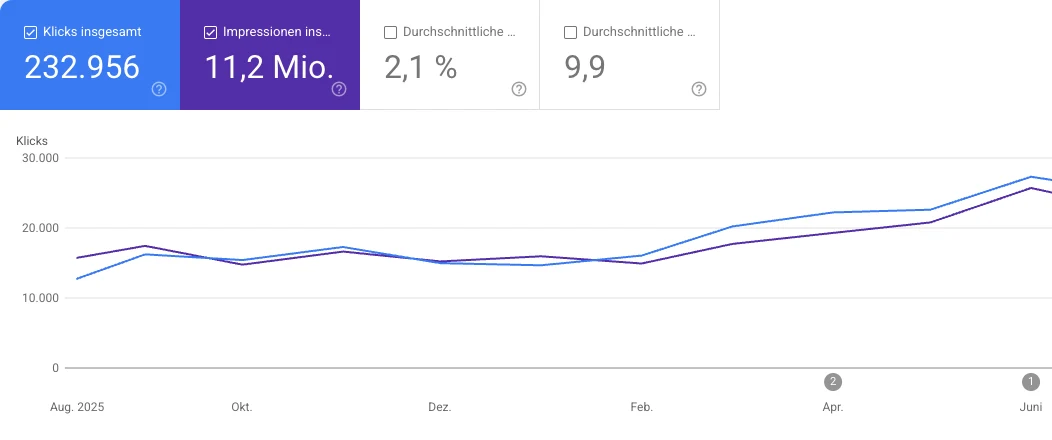
The French version came from an average position of 16.4 to 5.7, from page 2 into the top 6. Its clicks rose from around 26,000 to 41,000, up 56 percent, with impressions steady at about 500,000.
Across the tracked category and product pages, organic clicks grew from roughly 54,000 to 85,000, up 58 percent. Impressions rose 45 percent, from 3.5 to 5.0 million.
Individual purchase-ready pages made the difference. The outlet section jumped from position 45 to 4 and quadrupled its clicks. The garden-furniture lounge came from 17.5 to 9.7, and several home-section pages moved into the top 3. Non-brand terms like garden furniture, deck chair, and bathroom furniture also moved up visibly.
What follows from this
With a multilingual shop, the gain often sits in the weaker language and in a few purchase-ready pages. The brand brings its own traffic. Everything beyond that appears where language and purchase intent meet, and not in more content.
Next step